TL;DR — Traditional SEO tools count keywords. Helix AI's Semantic Analytics engine maps meaning. We fed a 23-minute pre-earnings preview and valuation video into Semantic Analytics and generated a structured intelligence report—topics, entities, domain terms, and narrative spine—without manual tagging.
1. The Broken State of Content Strategy
The modern content workflow is exhausting.
You export transcripts, scrape PDFs, scrub through videos, highlight numbers, and build half-manual outlines just to produce one “data-driven” article or analysis. By the time you hit publish, your insights are already stale.
This is the old SEO loop — a keyword guessing game dressed as strategy.
It assumes that “relevance” is a word match, not an understanding. But Google has evolved beyond that. Search now ranks based on conceptual alignment and semantic coverage. The future doesn’t reward those who write the most words. It rewards those who demonstrate the deepest comprehension.
So we asked a simple question:
What if you could compress a multi-hour research cycle into a single API call—and the output was not just a transcript, but a blueprint of understanding?
2. The Shift: From Keywords to Knowledge Graphs
Google’s evolution—from PageRank → BERT → MUM → AI Overviews—reflects a fundamental transition:
the web is no longer a bag of words; it’s a knowledge graph.
Each piece of content is a node. Its ranking power comes from how clearly it expresses entities (people, products, events) and relationships (who did what, why it matters).
The stronger those semantic signals, the more Google (and humans) can trust it.
That’s why we built Semantic Analytics—a system that transforms unstructured content into a graph of meaning:
topics → entities → phrases → relationships → narrative flow.
3. The Experiment: A 23-Minute Preview, One API Call
We picked a hard, forward-looking artifact: a valuation/technical preview, not a transcript of the earnings call itself. Previews blend historical trends, Street estimates, and chart context—exactly the terrain where keyword tools fail and semantic structure wins.
Source: The Investor Channel on YouTube
Title: "Google Q2 Earnings Preview | GOOGL Stock Valuation & Technical Analysis"
YouTube ID: 0sRKjaxfMf8
Source Disclosure: This analysis uses a pre-earnings preview video reflecting the creator's forward-looking views and technical setup prior to the July 26, 2022 earnings date, not the official results or press release. All numbers referenced from the video are as discussed by the analyst at that time.
By the Numbers: The Source Asset
| Metric | Value |
|---|
| Video ID | 0sRKjaxfMf8 |
| Duration | ~23 minutes |
| Channel | The Investor Channel |
| Published | July 2022 (pre-earnings) |
| Content Type | Preview/Valuation/Technical Analysis |
Pre-earnings previews are the ultimate AI stress test:
- Multi-modal: Voice, charts, and financial projections intertwined
- Dense with Jargon: Valuation multiples, technical levels, Street consensus
- Layered: Mixes forward estimates with historical trends and chart patterns
- Context-dependent: Meaning shifts based on market setup, comp performance, and timing
This is precisely the kind of forward-looking chaos our system is designed to make sense of.
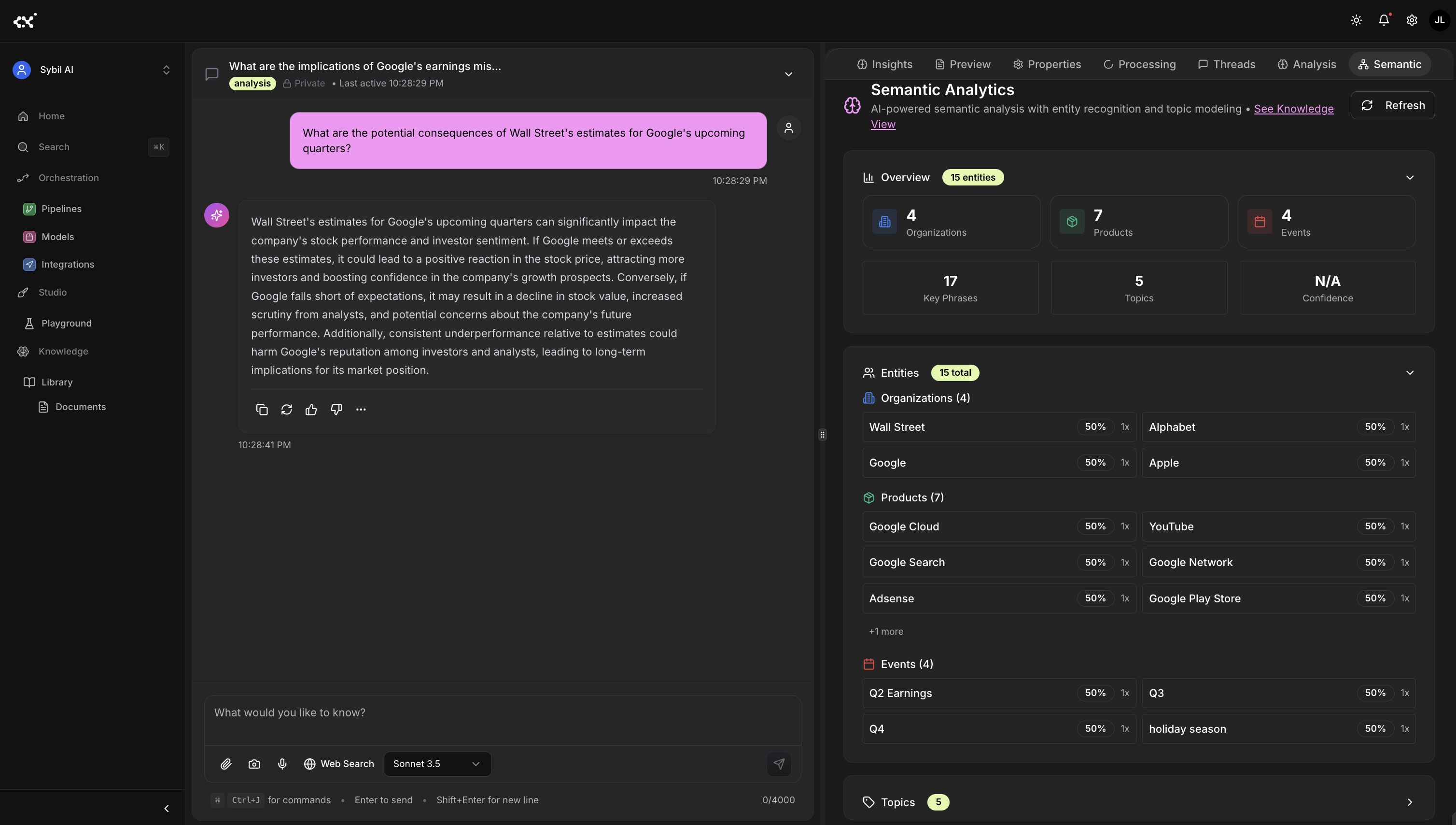
Helix AI automatically extracts entities, topics, and phrases across modalities — turning a 23-minute earnings preview into structured, machine-readable intelligence.
4. The Semantic Blueprint: What the Engine Found
🧠 Conceptual Topics — The "Why"
Instead of flat keywords, Helix identified the core arguments of the preview:
| Topic | Salience | What It Covers |
|---|
| Revenue Trendlines & Mix | High | Historical growth, segment weighting, ad cyclicality |
| Forward Estimates & Street Set-Up | High | Revenue/EPS ranges, scenario language, risk flags |
| Valuation Framework | High | Multiples, comps, margin-of-safety logic |
| YouTube & Creator Ecosystem | Medium | Monetization levers, softness/drivers |
| Google Cloud Trajectory | Medium | Growth vs. profitability debate |
| Snap/Ad-Market Read-Through | Medium | Cross-platform demand signals, spillover risk |
| Technical Structure & Levels | High | Support/resistance, momentum, entry/exit logic |
| Conclusion & Positioning | High | Buy now or wait framing |
Architectural Principle: This output is now your content brief's validation layer. Your mandate is to ensure every high-salience topic is addressed as a core section (<h2>) in your content. This is no longer a guessing game; it's a coverage test.
🏢 Entities — The "Who" and "What"
Entities spanned Alphabet/Google, YouTube, Google Cloud, Snap, Wall Street, and Q2 earnings timing—blending product lines with market participants and events (pre-results context).
| Type | Examples |
|---|
| Organizations | Alphabet, Google, Snap, Wall Street, The Street |
| Products & Segments | Google Cloud, YouTube, Google Search, Google Advertising |
| Events & Timing | Q2 Earnings (July 26, 2022), Forward Estimates, Guidance |
| Market Concepts | Ad Market, Creator Economy, Cloud Profitability |
| Domain Focus | Coverage |
|---|
| Valuation/Financials | Multiples, EPS, revenue mix, margins, buybacks |
| Technical Analysis | Support/resistance, chart patterns, momentum |
| Segment Deep-Dives | YouTube monetization, Cloud trajectory, Search trends |
| Market Context | Snap read-through, FX headwinds, ad demand signals |
Architectural Principle: Ground your content in this verifiable reality. Entities blend what was discussed (preview topics) with who/what matters (companies, products, events). Your workflow must validate your draft against this list and link to authoritative sources. This is how you align with Google's Knowledge Graph, not just hope for it.
💬 Domain Terms & Expert Language — The "How"
Domain language skewed to valuation/technicals plus ad-market signals. Helix extracted and contextualized the specialized vocabulary:
| Term | Domain | Context |
|---|
| Multiple Compression | Valuation | P/E ratio contraction due to growth slowdown or risk repricing |
| Support/Resistance | Technical | Price levels where demand/supply historically creates floors/ceilings |
| EPS Estimates | Finance | Wall Street consensus for earnings per share |
| FX Headwinds | Finance | Negative currency impacts on multinational revenue/earnings |
| Read-Through | Finance | Inference of sector trends from one company results (e.g., Snap to Google) |
| Cohort Behavior | Ad Tech | User engagement patterns by demographic or time segment |
| Net Cash Position | Finance | Cash reserves minus debt; signals balance sheet strength |
| Buyback Authorization | Finance | Board-approved share repurchase program |
Architectural Principle: Build your on-page proof of expertise directly from this list. Mandate the creation of an in-line glossary, tooltips, or a dedicated FAQ section. Use this output to programmatically generate schema markup. You will no longer claim expertise; you will demonstrate it with structured, machine-readable evidence.
📊 Key Phrases — The “Signals of Intent”
| Phrase | Relevance (%) |
|---|
| Google Search | 90 |
| big tech earnings | 85 |
| foreign currency movements | 85 |
| revenue estimates | 82 |
| total Google advertising | 80 |
| decent buying opportunity | 78 |
| individual business segments | 77 |
| earnings contraction | 75 |
| analyst estimates | 72 |
| missed expectations | 70 |
Architectural Principle: Treat these as metadata primitives. They should drive tags, section slugs, chapter markers, and cross-platform syndication. Your pipeline should persist them alongside the content graph for downstream clustering and analytics.
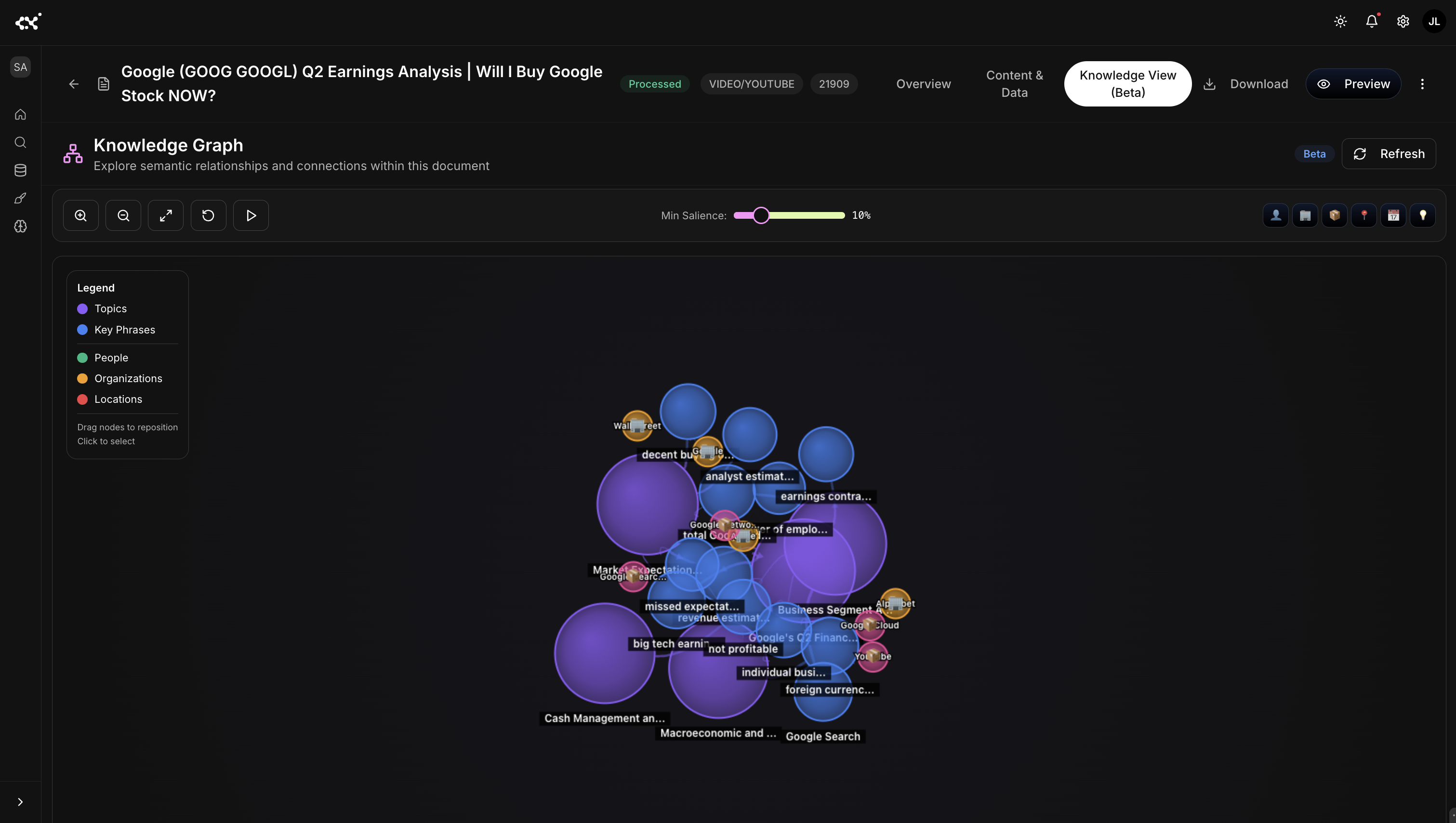
Each node represents a concept, key phrase, or entity. The clusters visualize the reasoning structure and semantic relationships uncovered by the engine.
🧩 Narrative Structure — The "When"
Helix mapped the video's chapter flow, preserving the creator's argument sequence:
- Intro (0:00) — Setup and context
- Revenue Trends (1:53) — Historical growth patterns and segment mix
- Forward Estimates (4:21) — Street consensus and expectations into earnings
- Valuation Analysis (5:20) — Multiples, comps, and margin of safety
- YouTube Analysis (7:50) — Monetization trends and creator ecosystem health
- Google Cloud Analysis (13:11) — Growth trajectory vs. profitability debate
- Snapchat Impact (17:09) — Cross-platform read-through and ad demand signals
- Technical Analysis (18:51) — Support/resistance levels and chart setup
- Conclusions (22:51) — Buy/wait verdict and positioning logic
Architectural Principle: Persist section boundaries + timestamps as first-class objects. They power chaptered UX (TOC anchors), content reuse (clips/snippets), and retrieval-augmented reasoning with precise temporal grounding.
5. The Intelligence Flywheel: From Blueprint to Action
A semantic blueprint is only valuable if you can act on it. The output from our engine isn’t a final report—it’s the input for a continuous intelligence flywheel:
- Create the Brief: The Topics and Entities instantly form a data-driven content brief that eliminates guesswork.
- Enrich the Content: The Domain Terms fuel glossaries and schema markup that demonstrably prove expertise (E-E-A-T).
- Automate Distribution: The Key Phrases and Narrative Structure drive tagging, clustering, and cross-platform syndication.
- Measure and Refine: The structured data closes the loop, allowing you to measure concept engagement and optimize future briefs.
This transforms a one-time analysis into a living intelligence system.
6. From Analysis to Action: What This Enables
| Persona | Problem | Helix's Outcome |
|---|
| Financial Analyst | Hours spent summarizing dense calls | Structured brief in < 2 min; exportable table of metrics |
| Content Strategist / SEO Lead | Guessing keywords, thin topical coverage | Semantic outline, verified entities, ready-made glossary |
| Product Marketer / PMM | Reverse-engineering competitor launches | Entity-linked feature mapping and thematic clustering |
| Compliance & Audit | No traceable reasoning chain | Explainable outputs with lineage and evidence anchors |
The same analysis that powers your SEO brief can populate a dashboard, trigger a workflow, or train a domain-specific agent.
7. The New Mandate for Content & Strategy Teams
Based on this level of intelligence, the standards for strategic content have fundamentally changed. High-performing teams will now be required to:
- Operate from a Semantic Core.
All content briefs must begin with a semantic analysis of top-performing assets. "Keyword difficulty" is an obsolete metric; "conceptual coverage" is the new KPI.
- Treat Content as Structured Data.
Every article and video is no longer just a creative asset; it is a structured dataset that must be observable, version-controlled, and programmatically connected to your broader knowledge graph.
- Automate Derivative Content, Not Just Creation.
The goal is no longer to use AI to write a first draft. The new mandate is to use a single, high-quality source asset to automatically generate a dozen consistent, high-fidelity derivatives.
- Measure What Matters.
Stop tracking keyword rank. Start tracking your share of voice across conceptual topics. Measure the density and accuracy of your entity coverage. This is how you measure authority in the eyes of an algorithm.
8. The Strategic Signal: From Content to Corporate Intelligence
While this analysis powers a superior content strategy, its implications are much broader. For strategists, corporate development teams, and M&A analysts, this technology represents a new alpha.
Imagine pointing this engine not at a YouTube video, but at a target company's entire data room, their patent filings, or their internal communications. The ability to extract and connect concepts at scale transforms due diligence from a manual sampling exercise into a comprehensive, queryable intelligence operation. This isn't just a marketing tool; it's a strategic radar.
9. This Isn’t Just Analysis — It’s Reasoning Infrastructure
What you just saw isn’t “semantic SEO.”
It’s Reasoning Transform & Load (RTL) — our architectural foundation.
We didn’t transcribe a video. We transformed it. We extracted logic, mapped concepts, and created a structured, queryable asset. This is the connective tissue between data engineering and intelligent automation—between understanding and action.
10. Conclusion: The Future Is Semantic & Synthesized
The next frontier of enterprise intelligence isn’t about analyzing more data—it’s about connecting it.
In a world where unstructured inputs outnumber structured by orders of magnitude, companies that can extract, align, and reason over concepts will outpace those still counting words.
Semantic Analytics is our first public step toward that future. It’s how you move from information overload to structured understanding—and from manual reporting to autonomous reasoning.
🚀 Call to Action
Ready to move beyond keywords?
Turn your unstructured content—videos, documents, or datasets—into structured, actionable intelligence.
👉 Book a personalized demo of Semantic Analytics in Helix AI
and see your first Reasoning Transform & Load (RTL) pipeline in action.
Author: James Labastida — Founder & CEO, Helix AI
Built for the age of multi-modal understanding, composable automation, and AI-native governance.
